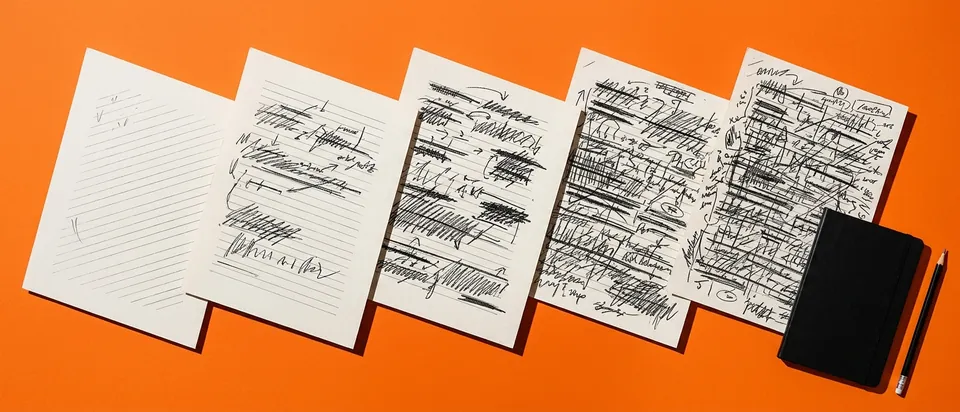
You prove you wrote something the same way you prove any history: with records made while you worked. Dated drafts, version history, notes, sources and people who saw the work in progress carry the most weight. No detector score should be the only evidence that someone did or did not write a work.
Being told your work "looks AI-written" is unsettling, especially when you wrote every word. Whether the accusation comes from a teacher, a client, a publisher or a platform, the way through is the same: show your process. This page is part of our AI and copyright guide.
No single item is proof on its own. Together, though, drafts, history and notes tell a story a fair reviewer can follow. This page explains which records carry weight, where to find them in common writing tools, why detector scores fall short, and how to present your case calmly.
01Evidence that carries weight
Think of evidence in three layers, from strongest to weakest.
Records made at the time
- Version history showing the text growing over days or weeks, with false starts and rewrites.
- Earlier drafts saved as separate files, emailed to yourself or shared with someone.
- Notes, outlines and research: handwritten pages, bookmarks, highlighted sources, photos of a whiteboard.
- Messages where you discussed the work with a tutor, editor, friend or collaborator.
Things only the author knows
- Why you chose a source, an example or a structure.
- Material you cut, and why.
- The ability to explain, extend or defend the work in conversation.
Supporting context
- Earlier work in the same voice and on similar topics.
- File metadata such as creation and modification dates, which helps but can be changed.
- Witnesses who saw you working.
For copyright purposes, the same records show which parts are your own expression. The US Copyright Office's Part 2 report, published January 29, 2025, concluded that "the use of AI tools to assist rather than stand in for human creativity does not affect the availability of copyright protection." Evidence of what you contributed is evidence of authorship.
02Version history in common writing tools
Most cloud writing tools keep a history automatically. Find it before you need it, and do not delete it.
Google Docs
According to Google's Docs Editors Help page on finding what changed in a file, you can open version history from the "Last edit" icon at the top right, see who changed what and when, and name important versions. Google's page notes some limits worth knowing:
- You need edit permission on a file to browse its earlier versions.
- Revisions may occasionally be merged, so not every keystroke is kept.
- You can add up to 40 named versions per document.
- Owners using a personal Google Account can permanently delete version history.
That last point cuts both ways: deleted history cannot be recovered, and a reviewer may ask why history is missing. If you are under review, leave it alone and make a copy instead.
Microsoft Word
Microsoft's support page, View previous versions of Office files, explains that you can select the file title and choose Version history. Two limits:
- Version history only works for files stored in OneDrive or SharePoint in Microsoft 365. A file saved only on your computer has no cloud history.
- With a personal Microsoft account, you can retrieve the last 25 versions. Work and school accounts depend on how the library is configured.
Other tools
Many writing apps, note apps and code platforms keep similar histories. Look for "version history", "revisions" or "snapshots" in the help pages for the tool you use, and export what you find as screenshots or copies with dates visible.
03Why detector scores are not proof
AI detectors estimate how likely it is that text resembles machine output. They do not observe how the text was made. That creates real limits:
- Scores are probabilities, not findings. A high score means the text shares features with AI writing, not that a machine wrote it.
- Some writing looks "AI-like" naturally. Plain, formulaic or heavily edited prose, and writing by people working in a second language, can score high.
- Tools disagree. The same text can get very different scores from different detectors, or from the same detector after an update.
- Editing changes scores. Light edits can move a score sharply in either direction.
This is why many institutions treat a detector result as a reason to look closer, not as a conclusion. The fair approach is to weigh the score against the process evidence above.
No detector score should be the only evidence that someone did or did not write a work.
04Presenting your case
- Ask what the concern is, in writing. Which work, which passages, and what evidence prompted it.
- Gather your records before the meeting: version history exports, drafts, notes, sources and messages.
- Build a short timeline. Dates, what you did, and which record shows it. One page is enough.
- Offer to explain the work. Walking a reviewer through your reasoning is often the most persuasive step.
- Stay factual and calm. Describe what you did. If you used AI in a permitted way, say so plainly.
- Ask about the appeal process and any deadlines, and keep copies of everything you send.
The idea is an old one. When the Copyright Alert System ran from 2013 to 2017, subscribers who believed an alert was wrong could ask for a review. Our archive page on how wrongly sent Copyright Alerts were reviewed describes that process.
If a platform has removed your work on the claim that it is AI-made, see our guide to AI-related takedowns and how to respond. If the issue is a school honesty charge, our page on whether using AI counts as plagiarism explains how those rules differ from copyright. Where a degree, job or contract is at stake, consider talking to an advisor or a lawyer licensed where you live.
05Building the record from now on
- Write in a tool that keeps history, and keep cloud files in the synced folder.
- Name versions at milestones: outline, first draft, after feedback, final.
- Keep your notes and sources in one folder per project.
- Record AI use honestly as you go, even when it is allowed. A short log ("used AI to check grammar on section 2") is easy to keep and hard to argue with.
- For images, audio and video, keep project files with layers and edit history. Content credentials can also record how a file was made; see content credentials and C2PA labels.
- Back up to a second place so an account problem does not erase your history.
For the legal background on why human authorship matters at all, see the editorial overview of authorship after Thaler v. Perlmutter.
Where the law is still moving
There is no agreed standard for what counts as proof of human authorship. Schools, publishers and platforms each set their own process. Detector tools change often, and provenance standards are still being adopted. In copyright registration, the Copyright Office decides human authorship case by case, as its January 2025 report says.
Sources
- Copyright and Artificial Intelligence, Part 2: Copyrightability
US Copyright Office · 29 January 2025 - Find what's changed in a file (Google Docs Editors Help)
Google · 30 October 2026 - View previous versions of Office files
Microsoft Support · 26 September 2026
How we pick and check these: our editorial method.
07Questions people ask
What should I do if I am falsely accused of using AI?
Start by asking for the specific concern in writing, then gather your version history, drafts and notes. Build a short dated timeline and offer to talk the reviewer through your work. Ask about the appeal process and keep copies of everything you submit.
Can version history be faked?
It is hard to fake convincingly, but not impossible, which is why reviewers look at several kinds of evidence together. Cloud histories record edits over time on the provider's servers. A long, uneven history with rewrites and dead ends is far more persuasive than a single pasted block.
Is Google Docs version history accepted as evidence?
Often, yes, as part of a wider picture. Many schools and publishers will look at it. How much weight it gets depends on the reviewer and the setting. It is strongest alongside drafts, notes and your ability to explain the work.
How do I prove I wrote something before AI existed?
Use dated records from the time: published copies, emails with attachments, backups, printed drafts and registration certificates. Copyright registration records with the Copyright Office carry an effective date that is useful evidence of when a work existed.